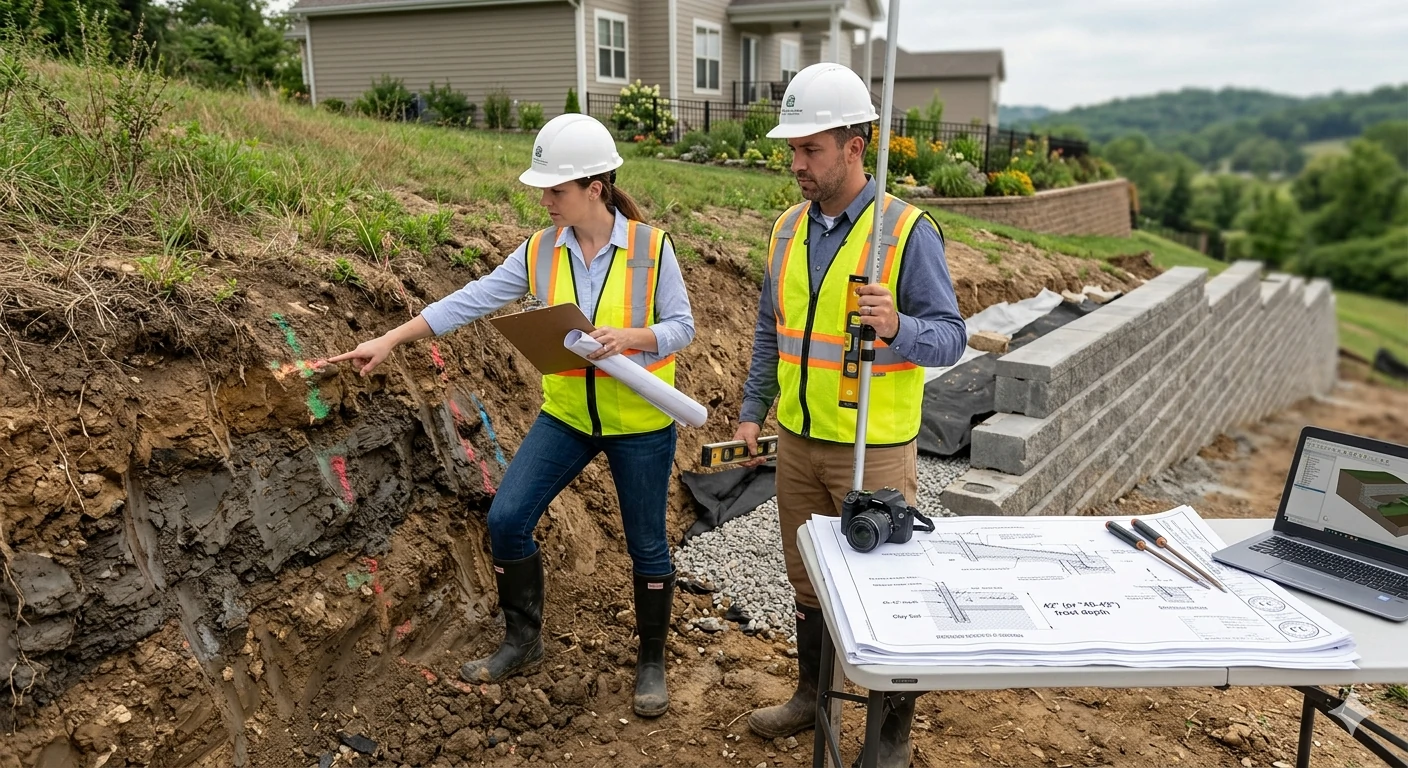
Why Chesterfield Slopes Demand Professional Wall Design
Most calls about retaining wall design in Chesterfield start the same way. A homeowner notices their yard is shifting, or a contractor tells them they need engineered drawings before the city will issue a permit. That's the reality here. The rolling terrain across Chesterfield creates natural grade changes that look harmless until water, gravity, and time start working against your property.
The soil conditions in this area make things tricky. Much of Chesterfield sits on expansive clay that swells when wet and shrinks when dry. That constant movement puts lateral pressure on any wall that isn't designed to handle it. A wall built without proper engineering might hold for a year or two, then you'll see the lean, cracking along the base, separation at the joints. The team sees this regularly in neighborhoods near Chesterfield Valley where the flood plain meets steeper lots. The proper structural solutions are provided by engineering design specialists.
Here's what most people don't realize. A retaining wall over four feet tall typically requires a permit in St. Louis County, and that permit requires stamped structural drawings from a licensed engineer. Not a sketch from your landscaper. Not a detail pulled from a supplier's catalog. The municipality wants to see:
- Soil bearing capacity assumptions based on local conditions
- Drainage design behind the wall to manage hydrostatic pressure
- Footing depth and reinforcement sized for the actual retained height
- Surcharge loads from driveways, structures, or slopes above the wall
Skip any of those and your plan gets kicked back. That's where most projects stall out.
And the stakes aren't just about permits. A failed retaining wall can undermine your foundation, flood a lower-level living space, or dump soil onto a neighbor's property. According to the American Society of Civil Engineers, earth-retaining structures are among the most common sources of residential construction disputes. Professional retaining wall design isn't an upgrade. It's the baseline for doing this right on Chesterfield's terrain.

What the Retaining Wall Design Process Actually Looks Like
Most people picture a retaining wall project starting with a shovel in the ground. It actually starts at a desk. The team needs to understand your soil, your slope, your drainage situation, and what's sitting above or below the wall before a single line gets drawn.
Here's how the process works from start to finish:
- Site evaluation. The team reviews your property's grade changes, existing drainage paths, and any structures nearby. In Chesterfield, a lot of properties along the Wildwood border have clay-heavy soil that behaves differently under load than what you'd find closer to the river valley. That matters.
- Soil and load analysis. Retaining wall design depends on understanding lateral earth pressure. The team calculates surcharge loads, anything sitting on top of the slope like a driveway, a deck, or heavy landscaping.
- Wall type selection. Gravity walls, cantilevered walls, segmental block, poured concrete. Each one fits a different situation. A 3-foot wall next to a patio is a different conversation than a 7-foot wall holding back a hillside.
- Structural drawings. This is where the design becomes a permit-ready document. Dimensions, reinforcement details, footing depth, drainage specs, everything the inspector needs to see on one sheet.
- Permit coordination. The team stamps the drawings and makes sure they meet local code requirements so your contractor can pull the permit without delays.
The whole thing usually takes a couple of weeks from first call to stamped plans. The biggest holdup isn't the engineering. It's waiting on a survey or geotechnical report that should've been ordered earlier.
A wall over 4 feet in most jurisdictions requires engineered plans, not optional. Your contractor might be willing to build without them, but the municipality won't sign off on the final inspection. Properties in neighborhoods like Chesterfield Valley see this come up constantly with grading projects.
The team handles retaining wall design as a complete package, from the initial site review through structural calculations and stamped permit drawings your contractor can build from.
Soil Conditions and Frost Depth Shape Every Design Decision
Most people call about a retaining wall because they see a slope they don't like. Fair enough. But the slope is only half the story. What's happening underground matters more than what's happening on the surface.
Chesterfield sits in the Missouri River floodplain and the surrounding bluffs. Soil conditions change a lot from one property to the next. A home near Chesterfield Valley might have loose alluvial fill placed during commercial development. Up toward Wildwood or the neighborhoods along Baxter Road, the team often finds heavy clay with poor drainage. Both situations demand a different approach to retaining wall design, and getting it wrong means your wall moves within a few years.
Here's what the team evaluates before any design work starts:
- Soil type and bearing capacity. Clay expands when wet and shrinks when dry. Sandy fill drains fast but can settle unevenly. Each one changes how deep the footing needs to be and how much reinforcement goes behind the wall.
- Water table and drainage patterns. A wall holding back saturated soil carries far more lateral pressure than one in well-drained ground. The team sees this every week in Chesterfield properties that back up to natural drainage swales.
- Frost depth. Missouri's frost line sits around 24 inches. According to the International Building Code, footings need to extend below that depth to prevent heave. A footing that's too shallow will shift when the ground freezes, cracking the wall above it.
The contractor who gave you a number without asking about any of this picked a wall height, guessed at a footing size, and moved on. That's how you end up with a wall that leans 18 months after it's built.
The structural calculations account for all of these variables, soil weight, surcharge loads from driveways or structures above the wall, hydrostatic pressure. Every number ties back to what's actually in the ground on your property. And if a geotechnical report already exists from a prior project or home purchase, the team can work from that data directly.
Permits, Engineering Stamps, and What Chesterfield Requires
Most retaining wall projects in Chesterfield need a permit. That's the part that catches people off guard. A contractor says "we can start next week," and nobody mentions the engineering drawings the city wants to see before any dirt gets moved.
Chesterfield follows the International Building Code, and the general rule is straightforward. Any retaining wall over four feet in exposed height requires stamped structural drawings from a licensed engineer. Drop below four feet and you might think you're in the clear, but there's a catch. If the wall carries a surcharge load, a driveway, a slope above it, or a structure within a certain distance of the top, the city can still require engineered plans. The team sees this come up constantly near Wildhorse and along the hillier lots on the Clarkson Valley border.
Here's what Chesterfield typically requires for a retaining wall permit:
- Stamped structural calculations showing the wall can handle earth pressure and any surcharge loads
- A site plan with the wall's location, height, and distance from property lines
- Structural permit drawings showing reinforcement details, footing depth, and drainage
- Soil conditions or a geotechnical report when the city asks for one
Permits get held up because the drawings are missing drainage details or the calculations don't account for the slope above the wall. Those are the two things plan reviewers flag first. And if your contractor submitted a generic detail sheet from a block manufacturer, that's almost always getting kicked back.
The team stamps every set of retaining wall design drawings with a Missouri PE seal. That stamp tells the plan reviewer an actual engineer took responsibility for the design, not just a drafting service running software. It's the difference between a two-week review and a months-long back-and-forth.
So if your project is anywhere close to that four-foot threshold, get the engineering done first. It keeps your contractor on schedule and means no surprises when the inspector shows up.
Drainage Is Structural, Not Optional
Most retaining walls that fail in Chesterfield don't fail because of bad concrete or weak blocks. They fail because nobody planned for water.
That's the thing the team sees over and over. A homeowner calls because their wall is leaning or cracking, and the issue traces back to drainage. Water builds up behind the wall, the soil gets heavier, and hydrostatic pressure starts pushing against the structure from the back side. A wall designed for 80 pounds per cubic foot of soil pressure is now dealing with 120 or more. The math stops working fast.
Proper retaining wall design treats drainage as a structural element, not an afterthought. Here's what that looks like in practice:
- A drainage aggregate layer behind the wall face to give water a path downward
- Perforated drain pipe at the base, pitched to daylight or a catch basin
- Filter fabric separating the aggregate from native soil so clay doesn't clog the system
- Weep holes through the wall face at regular intervals for additional relief
Skip any one of those and you're building a dam, not a wall.
Chesterfield's clay-heavy soils make this worse. Clay expands when it's wet and shrinks when it dries. That seasonal cycle puts lateral pressure on your wall that changes month to month. Properties near Chesterfield Valley or along the lower elevations off Wild Horse Creek Road deal with higher water tables on top of that. The design has to account for worst-case saturation, not average conditions.
According to the Federal Highway Administration, inadequate drainage is the leading cause of retaining wall distress in residential and municipal applications. That lines up with what the team sees locally.
When you're reviewing a retaining wall design, look at the drainage details first. If the plans don't show pipe sizes, aggregate specs, and outlet locations, they're incomplete. Your permit reviewer will likely flag it too. But more importantly, your wall's long-term stability depends on getting water away from the structure before it becomes a load the wall was never designed to carry.
Frequently Asked Questions
Do I need a permit for a retaining wall in Chesterfield?
Yes, most retaining walls over four feet tall require a permit in Chesterfield and St. Louis County. That permit requires stamped structural drawings from a licensed engineer. Your contractor cannot pull the permit with a landscaper sketch or a supplier detail sheet. The city wants to see soil assumptions, drainage design, footing depth, and surcharge loads. Skipping this step means your final inspection won't pass.
Why do retaining walls in Chesterfield fail faster than expected?
The clay soil in Chesterfield is the main reason. It swells when wet and shrinks when dry, which puts constant lateral pressure on any wall not designed for it. Walls built without proper engineering often look fine for a year or two, then start leaning or cracking at the base. Properties near Chesterfield Valley are especially prone to this because of the mix of flood plain soil and steeper lot grades.
How long does retaining wall design take from first call to stamped plans?
Most projects go from first call to stamped, permit-ready drawings in about two weeks. The engineering itself moves quickly. The biggest delays come from waiting on a property survey or geotechnical report that should have been ordered earlier. If you already have a recent survey, the process moves faster. Getting those documents lined up before you call saves real time on your project schedule.
Does the type of soil on my property change the wall design?
Yes, soil type changes almost every part of the design. Properties near Chesterfield Valley may have loose alluvial fill that settles unevenly. Lots along Baxter Road toward Wildwood often have heavy clay with poor drainage. Each situation needs a different footing depth, reinforcement plan, and drainage approach behind the wall. A contractor who gives you a price without asking about soil conditions is guessing, and that guess usually shows up within a few years.
What happens if I skip the engineering and just have a contractor build the wall?
Your contractor can build it, but the municipality won't sign off on the final inspection. Beyond the permit problem, a wall built without proper engineering can undermine your foundation, flood a lower-level living space, or push soil onto a neighbor's property. The American Society of Civil Engineers lists earth-retaining structures as one of the most common sources of residential construction disputes. Skipping engineering trades a short-term cost saving for a much bigger long-term problem.
How does Missouri's frost depth affect my retaining wall footing?
Missouri's frost line sits around 24 inches deep. Footings need to go below that depth to prevent heave when the ground freezes. A footing that's too shallow will shift with freeze-thaw cycles and crack the wall above it. This is a detail that gets missed often on DIY or under-engineered walls in Chesterfield. Proper retaining wall design accounts for frost depth from the start, not as an afterthought.